Australian Leadership Skills Centre


Practical, personalised leadership coaching that builds confidence, capability and real‑world results
COACHING
Coaching is a core part of the Australian Leadership Skills Centre’s approach to developing leaders. It provides the flexibility, focus, and individual attention that traditional training alone cannot offer. Whether supporting emerging leaders, strengthening executive capability, or addressing specific performance challenges, coaching creates space for meaningful reflection, targeted development, and lasting behavioural change.
Our coaching programmes are practical, people‑centred, and grounded in real workplace challenges. We work closely with individuals and organisations to build clarity, confidence, and capability - helping leaders perform at their best and create positive impact across their teams and workplaces.
Our coaching approach
We design coaching that is:
-
Personalised — tailored to each leader’s goals, strengths, and development needs
-
Practical — focused on real challenges, real conversations, and real outcomes
-
Flexible — delivered over short, intensive periods or longer-term engagements
-
Insight‑driven — supported by high‑quality profiling tools and 360‑degree feedback
-
Outcome‑focused — designed to build capability, confidence, and behavioural change
Our coaches bring deep experience across leadership, organisational development, government, education, consulting, and executive roles. This breadth allows us to match each client with a coach who understands their context and can provide meaningful, relevant guidance.
Coaching Solutions We Provide
We offer coaching for:
-
Personal Development - building confidence, communication, and self‑awareness
-
Executive Coaching - strengthening strategic thinking, influence, and leadership presence
-
Business Coaching - supporting decision‑making, planning, and organisational performance
-
Performance Coaching - addressing behavioural or performance challenges constructively
Coaching can be delivered one‑on‑one, as part of a leadership programme, or integrated into broader organisational development initiatives.
The Coaching Process
Our coaching is highly flexible and responsive to individual needs. It can be delivered:
-
over extended periods for sustained development
-
in short, intensive blocks for targeted support
-
alongside training programmes to reinforce learning
-
as a standalone intervention for specific challenges
We work collaboratively with clients to set goals, build insight, and support meaningful, sustainable change.
Coaching tools we use
We draw on a range of evidence‑based tools to support insight and development. These tools help leaders understand their work preferences, communication style, emotional intelligence, and development priorities — forming a strong foundation for targeted coaching.
TMP
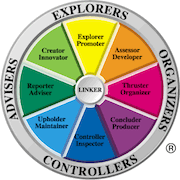
Team Management Profiling
is a great tool to improve self-awareness and team dynamics.

Linking Skills
Linking Skills provides individuals with 360 degree feedback on a range of essential people linking skills.

MSCEIT
MSCEIT measures Emotional Intelligence as a skill, helping individuals improve self-awareness, empathy, and relationships.

Train to be a coach and mentor
6 months training programme
For leaders wanting to build coaching capability themselves, our Leading Through Mentoring and Coaching Programme provides a practical, structured pathway to develop these skills.
Case study: Transforming a High-Risk Leadership Situation
We were engaged to address a serious and long‑running conflict in a large organisation involving a senior manager - let’s call him Bert - and many of his peers and leaders. Communication had broken down almost entirely, trust was non‑existent, and Bert was widely regarded as a “rogue operator” whose behaviour posed significant risk. This was a stark contrast to his earlier reputation as a highly capable and respected senior manager.
After months of disputes, performance issues, and personality clashes, Bert was on the brink of dismissal. As a final attempt to resolve the situation, his boss placed him on a Performance Improvement Plan and engaged us to analyse the issues, design a coaching intervention, and stabilise the deteriorating environment.
The beginning of the coaching process was extremely high stakes. Bert had no trust in management, and that distrust initially extended to us as external coaches. Establishing rapport was critical - and because building trust is one of our core strengths, we were able to overcome this barrier quickly and begin meaningful work.
We started by gathering evidence to understand the situation clearly. Using our coaching tools - including the Team Management Profile (TMP), Linking Skills, and the MSCEIT emotional intelligence assessment - we collected feedback on Bert’s performance, communication patterns, and interactions with peers and colleagues. These insights helped us understand both the external dynamics and Bert’s internal paradigm, giving us a grounded foundation for the coaching process.
With trust established, we worked intensively with Bert to replace unhelpful habits with constructive ones. This included:
-
rebuilding communication as a daily, non‑negotiable practice
-
recognising and managing the emotional aspects of interaction and decision‑making
-
developing greater self‑awareness and accountability
-
strengthening relationships with colleagues and leaders
During this process, we also identified broader leadership and cultural issues within the organisation that were contributing to the conflict. While these were outside the scope of our engagement - and beyond what the organisation was willing to address at the time - acknowledging them helped contextualise the challenges and ensured our coaching approach remained realistic and grounded.
Despite these constraints, the shift in Bert’s behaviour and relationships was profound. Once trust was established, he engaged positively with the coaching, rebuilt relationships with his peers and managers, and transformed from a high‑risk, isolated operator into a valued and collaborative member of the leadership team. His motivation increased, his behaviour stabilised, and he even began volunteering to support others across the organisation.
Key outcomes included:
-
significant improvement in communication and emotional regulation
-
repaired and strengthened relationships across the leadership group
-
a sustained shift from conflict and risk to trust and collaboration
-
renewed confidence in Bert’s leadership capability
Today, Bert continues to perform at a high level and maintains strong, trusting relationships with his colleagues and managers. This case demonstrates the power of targeted, evidence‑based coaching, not only to change behaviour, but to restore confidence, capability, and connection even in complex organisational environments.
